Now that the mast is out, I have spent a week taking anything out of the interior that could rattle, rub, break loose, shift, or cause mayhem. This list includes a large part of the vessels interior. The boom and the gaff had to be packed inside the boat and all the lifelines and blocks had to be tied and seized so they wouldn't come loose during travel and wear a hole in something. For me it was a great week all by myself. I slept in the boat at night and had the entire seashore to myself. It was a time of reflection and rejuvenation, and of course a great time spent messing about in a boat.
 Thursday, December 28, 2006
Moving a Sailboat 4 - 498
Now that the mast is out, I have spent a week taking anything out of the interior that could rattle, rub, break loose, shift, or cause mayhem. This list includes a large part of the vessels interior. The boom and the gaff had to be packed inside the boat and all the lifelines and blocks had to be tied and seized so they wouldn't come loose during travel and wear a hole in something. For me it was a great week all by myself. I slept in the boat at night and had the entire seashore to myself. It was a time of reflection and rejuvenation, and of course a great time spent messing about in a boat. 

Friday, December 22, 2006
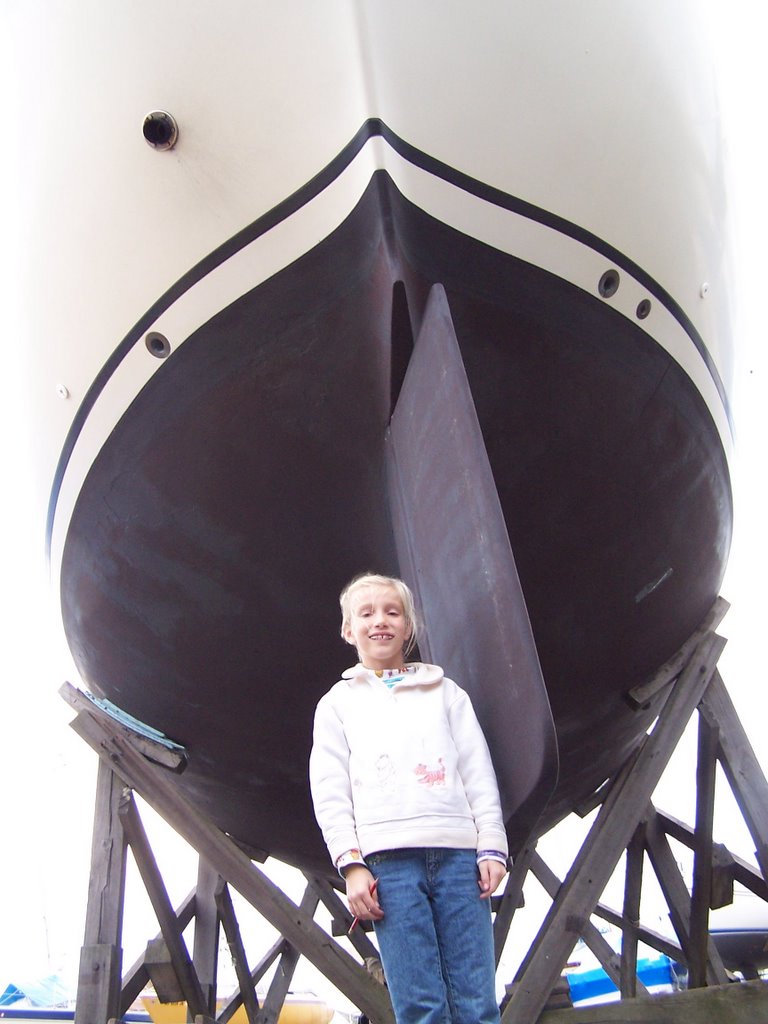
The boatyard is a playground.

 My children think it is normal to spend the day at a boatyard playing. It is amazing what they find to play with. Bianca is a caped horse rider. She looks really bored because we don't own a TV and have a gaming system. What a deprived child. I am sure her development is being stunted.
 Moving a Vessel 3 - 504

The mast has to be removed and packed up for transport. I removed every single piece of wire and line so that there would not be any ch afing.
 afing.
 The mast still had to be bubble wrapped so that the roller furling foil would not rub against it.
Thursday, December 21, 2006
Moving a Boat Part 2 - 505
 The next step to transporting a wooden boat is to pressure wash the bottom of the boat (gently so you don't blast the cotton caulking out) and apply linseed oil. I used a mixture of 75% linseed oil to 25% mineral spirits. (The recipe given me by my surveyor.) About half of the "experts" tell me I should use boiled linseed oil. The other half tell me to use regular linseed oil. This tells me that it doesn't make a difference. Use what you can get - in my case boiled. I applied five gallons of this mixture in four coats. I learned that the easiest way to apply is with a thick nap paint roller applied from the bottom of the boat and rolling up, then the side of the boat doesn't drip all over you. The linseed oil keeps the boat from drying out quickly, and it looks good.
Tuesday, December 19, 2006
Moving a Ship Part 1 - 507
 This is the first step to getting a boat from Massachusets to Michigan. You have to get it out of the water. The first thing I found out is that everybody is not willing to lift a wooden boat. Apparently many wooden boats are soft mush piles that have been neglected and in some state of sinking for many years and the last thing you want to do is stress the boat by lifting. No amount of talking could convince some marinas to lift me out and set my vessel on a semi. Foster Rigging and Yacht Service is one place that convinced me they had the know how to lift my boat without damaging it and set it on a semi. They are EXTREMELY expensive though.
 Everything went well.
Monday, December 18, 2006
Repairing the Rot - 508


The great part about a wooden boat is that it is made up of individual pieces. Each piece can be inspected and if necessary, replaced. In this case, luckily the plank was pretty short and can be removed relatively easy and replaced. Notice the lack of fiberglass dust, grinding, epoxy or fiberglass resin or face masks and tyvec suits. Just some sawdust, a piece of wood, and some cotton. Ahhhhhhh. . . .
Edit: When the board was removed, it wasn't actually rotten. The outer layer of wood had separated on the edge making it feel soft. If I had known better, I would have left this piece alone. Especially since the end of this wood just covers over another solid piece of wood.
Saturday, December 16, 2006
Listening to the Surveyor - 510

This X mark so unceremoniously scratched on the hull of our boat is a rotten spot. The boat is not perfect. Stomach churns. Owner shifts weight from foot to foot. World shifts on axis. Etc. I did what everyone else suffering from Sailboat seizure does - I bought the boat anyway.
Edit: When the board was removed, it wasn't actually rotten. The outer layer of wood had separated on the edge making it feel soft. If I had known better, I would have left this piece alone. Especially since the end of this wood just covers over another solid piece of wood.
Friday, December 15, 2006
How to Buy a Boat 3 - Day 511


When you finally find a surveyor that you think you can trust - pay him or her well. This person is your only defense against a disease that has you completely in your grips. You are at this exact moment suffering from a sailboat seizure (keel induced infarction). The signs that you are suffering from this insipid disease are: 1. You are talking to someone about spending all your money on something that MIGHT hold its value, will most likely lose value and will either end up on a reef or stuck in the mud. 2. You are standing next to a boat that you don't own and would like to own. 3. You have looked at yachtworld.com or have entered a building with the word "broker" anywhere on it.
The surveyor (as soon as he or she is paid) will do something THAT YOU CANNOT DO AT THIS POINT. The surveyor will inspect your vessel and tell you what condition it is really in. The reason you need this is you are suffering from a sailboat seizure, the owner doesn't really know and wouldn't tell you anyway if he did, and the broker may know but he isn't telling the owner or especially you what he knows. (See previous post).
The surveyor does all this with a magical little device called a hammer. He will tap the hammer in a pattern that manages to touch the boat every two square inches. It is amazing to watch, and only someone who is suffering a keel induced infarction will be able to watch another person tap a 30 foot object all day every two square inches with a hammer. But to you at this point it will seem amazing and sound musical.
NEXT, the hard part - listening to the words coming out of the surveyors mouth.
Friday, November 24, 2006
How to buy a boat Part 2 - Day 535
As soon as you find the vessel that is the best compromise for your conflicting needs (like space vs. money), the lies start. Lies. For instance, every broker you talk to has several people who are going to be looking at the boat you are interested in within the next couple of days. I have sold several boats. The number of people looking at your boat at any given time is usually zero. So when a broker tells you of all the people that are looking at the boat you are looking at he is telling preposterous lie. In the last year every broker I talked to told a new twist on the same old lie: Nobody looked at this boat for months, and then all of a sudden I have been getting a ton of calls to look at it. Ton of calls all of a sudden = you. It is like brokers everywhere get together and decide that the old line isn't working anymore and that they better use a new one.
The next batch of lies you will get in buying the boat are the reasons the boat is getting sold and the condition it is in. Health reasons, devorce, and disinterested children seem to be the top three. Like anything in life, the reason for selling a boat are a little more complex. I find that keeping up with the maintenance on the boat is the real main reason for selling a boat, and most boats for sale show lack of any real maintenance. The most important thing to realize is that ANY boat you buy has problems, expecially if it is brand new or looks brand new.
This is the crux of the problem: When you buy a boat, everyone is lying to you. The broker is lying (even your broker - see the book "Freakonomics" to understand this), the manufacturer is bending the truth as much as possible (see Catalina tell you how their boats are world cruising vessels), the owner hides the truth as much as possible, and the magazines are implicit in not exposing any of the above three parties who pay so dearly needed advertising dollars.
This is the solution: Buy someone you trust. Surveyors. Surveyors can be part of the problem expecially if they are recommended by the broker or buyer. The best bet is to find one yourself and then pay them well and give them plenty of time to find the problems. Not really sure, get two surveyors. There is absolutely nothing more expensive than saving money on a surveyor. One problem on a 30,000 dollar boat can take more than that to fix. Spending a couple grand on a surveyor is the best money you will ever spend on a boat.
I found my surveyor by reading. My surveyor came up in several books and magazine articles, and oddly enough he was also on the list my broker recommended. It took a month to get a survey scheduled. The owners hate waiting, the broker howled citing the above "other people are looking at this boat" rule. Ignore all of this. DO NOT BUY A BOAT UNLESS A SURVEYOR YOU TRUST SPENDS AND ENTIRE DAY GOING THROUGH THE BOAT. The buyer and seller will have twenty other solutions other than waiting the month to get your surveyor look at the boat and will put unbelievable pressure on you to do otherwise. Pressure filled with lies.
The next batch of lies you will get in buying the boat are the reasons the boat is getting sold and the condition it is in. Health reasons, devorce, and disinterested children seem to be the top three. Like anything in life, the reason for selling a boat are a little more complex. I find that keeping up with the maintenance on the boat is the real main reason for selling a boat, and most boats for sale show lack of any real maintenance. The most important thing to realize is that ANY boat you buy has problems, expecially if it is brand new or looks brand new.
This is the crux of the problem: When you buy a boat, everyone is lying to you. The broker is lying (even your broker - see the book "Freakonomics" to understand this), the manufacturer is bending the truth as much as possible (see Catalina tell you how their boats are world cruising vessels), the owner hides the truth as much as possible, and the magazines are implicit in not exposing any of the above three parties who pay so dearly needed advertising dollars.
This is the solution: Buy someone you trust. Surveyors. Surveyors can be part of the problem expecially if they are recommended by the broker or buyer. The best bet is to find one yourself and then pay them well and give them plenty of time to find the problems. Not really sure, get two surveyors. There is absolutely nothing more expensive than saving money on a surveyor. One problem on a 30,000 dollar boat can take more than that to fix. Spending a couple grand on a surveyor is the best money you will ever spend on a boat.
I found my surveyor by reading. My surveyor came up in several books and magazine articles, and oddly enough he was also on the list my broker recommended. It took a month to get a survey scheduled. The owners hate waiting, the broker howled citing the above "other people are looking at this boat" rule. Ignore all of this. DO NOT BUY A BOAT UNLESS A SURVEYOR YOU TRUST SPENDS AND ENTIRE DAY GOING THROUGH THE BOAT. The buyer and seller will have twenty other solutions other than waiting the month to get your surveyor look at the boat and will put unbelievable pressure on you to do otherwise. Pressure filled with lies.
Thursday, October 19, 2006
How to Buy a Boat - Day 566

We just spent the last five years looking for the Sailboat that is the best compromise for the criteria that we are looking for to embark on a major open ended sailing trip. Five years. So I have a few guidelines for anyone else looking for just such a vessel.
1. Read. You are not going to be able to sail every type of boat you are thinking about using. All the guides say to sail as many types of vessel as you can so you can decide what you want and I agree. The problem with this thinking is that you are not going to be able to decide what you want just by Sailing in a boat once. We don't really get to know a Sailboat until we have owned it for about three years. I can tell you more about your vessel having owned it for three years than you will ever know by chartering it for a week. You are going to have to find other owners and read their very biased opinions on what they have. I tend to listen less to what they say and watch more closely what they are doing. Someone who thinks Catalina's are great vessels to take across oceans but has never left the Great Lakes probably doesn't have much to add. Yes, there are people who have sailed a Catalina 27 around the world, but if you look at the typical Catalina 27 owner they like to stay within 25 miles from shore. I also look at how long they have been doing it. I will put more credence in someone who has been sailing 25 years over the couple that just bought their boat (that would be me)

2. Travel. You cannot find out what works by just looking at vessels on yachtworld.com. You have to find out for yourself what is working out in the real world. We visited Vancouver BC, Houston TX, Florida, Southern California, Boston and the entire West Coast of Michigan. In doing this we were able to get to know what many vessels were really like, and more importantly what their owners are like and how the boats were really being used. You find out very quickly what does and does not work in a hurry.
3. Sail. Pick a small inexpensive vessel and sail it as often as possible. I think this is the most skipped step of them all. Everyone is all abuzz about having the right boat and navigation system and electrical system and engine and keel and bla bla bla. You cannot use any of these if you don't know how to sail a vessel. Don't fall into the trap of sailing for ten years but sailing the same year over ten times. Go out in ridiculous conditions, learn what your boat does in heavy weather. Learn to sail in light winds. Learn. You cannot pick a boat if you don't know what floats yours. We got very used to having only 27 feet of boat. We don't want the expense of maintaining a 45 foot vessel. 27 is enough. When we started searching we knew that anything over 35 feet would bury us financially for maintenance and for the fun of taking it out. Next time you get to a harbor look at what size is out on the water SAILING. It is all the smaller boats. We also knew a 27 foot boat is enough to handle anything out there because we have been in it. We know what an 80kt microburst feels like. We have been in those conditions you read about in books where you cant hear anything over the wind in the rigging, or see anything unless you are on the peak of the wave. If you don't sail you will not know what you need and you will make buying decisions based off of the magazines or worse a broker at a boat show. DO NOT BUY A VESSEL BASED OFF OF WHAT YOU READ IN A MAGAZINE OR GET TOLD BY A BROKER. They have no basis in reality. Sail, Sail, Sail.
3. Trust someone. You are going to have to find a sailor you resonate with and trust them. If you follow Steve and Linda Dashew you are going to end up with a very large systems based vessel built with the idea of outrunning and avoiding weather. If you follow Eric and Susan Hiscock you are going to end up with a smaller and simpler vessel built to take care of itself. What kind of sailor are you? Do you want to have a washer and drier? The Dashew's are your people. Do you have less than 300k in your bank account? The Hiscock's are your people. We stumbled upon a couple we decided to trust by mistake. We chartered a Balboa 26 in the Florida keys for two weeks one winter that was designed by Lyle Hess. I loved how it sailed. When it came time to find a vessel to cross oceans with I started looking into what else he designed. It was either Lyle Hess or Bob Perry in my mind. I found out Lyle Hess also designed the Ensenada 22, our first and very well liked vessel. I also found that you can't do a search on Lyle Hess, who had passed away ten years ago, without hearing about the Pardey's. All of a sudden Larry and Lynn Pardey were everywhere I looked. I bought one of their books, "Self Sufficient Sailor" and loved it. They seemed like no nonsense people. I decided to go to one of their seminars more to see if they were full of crap than to listen to the seminar. We met two very easy to meet people who love sailing, and people. We decided that we would listen. Our new boat was built at the same time and along the same lines as their current vessel Taleisin. We have found little to disagree with in the Pardey philosophy, the main differences in that they have no children and they are very small people. That is another day's topic
Sunday, July 02, 2006
This man is clueless - 705

I purchased a sextant this winter because . . . they look so cool. The problem is that understanding what the angle means as far as your location requires M A T H, something I am trying to skip learning as a lifelong goal. I hate conflicting goals.
Saturday, February 18, 2006
Winter Blues

January and feburary are the longest, most expensive months to live in Grand Rapids, MI. I find myself caught between two very large extremes. On one hand, can not wait to get out of here and just be done with bills, house payments, heating expenses ect. Just be debt free and take off with enough in your pocket to get to the next place. On continue on in the same fashion...not worry.
On the other hand, I kind of like having the next few years figured out and having the comfort and conveinences of knowing that I have Job...income. I have a home...i actually enjoy paying bills as long as i stay in black. Settling...that's what you call it. Settle down and have a nice place with some kids and grow old.
I wonder if we will ever get to that point...free of ties that bind us to our present lives or situations...free of the comforts and luxuries that we cling to with some sort of false sense of comfort. Do I dare let go of these things...am i worried that i might change...have to change...grow into a differant person? I fear it...I like how i am i think. I hate change...but change forces me to grow.
I choose to grow.
Monday, December 19, 2005
Sailing and the Bus

My wife told me about a friend of hers who is teaching people how to ride the bus. I thought to myself, "How silly, how hard can it be." I found out that my sheltered suburban life had a huge hole in it. I bought a month pass for the system and found out that the bus system in Grand Rapids is complex. Some busses run all week, while other skip Sunday or Saturday. They run different routes depending on the hour of the day. If you do not have the guide with you forget it. I find myself sitting on the bus feeling conspicously wealthy. I have the only Ipod in sight. My backpack is huge. I wear gold rings. It is amazing to me how many people do not ride the bus. We as a family are learning how to ride the bus! It sounds silly to say but you really have to learn the system, where all the stops are and where you can go and when. Someday when I go to school in Vancouver, BC I think this will pay off. Or the day we find ourselves in Istanbul trying to figure out their system knowing ours first should help. I hope. We figure that having a sailboat and using public transportation when on land go hand in hand.
Thursday, December 15, 2005
The Bus- 904

One thing i know for sure, it's cold. And wow Christmas is coming fast. Another thing i know for sure is that on-line shopping is the best way to shop; quick and easy.
The family and I (our crew) are all trying to figure out how to save and conserve our money for our voyage. We have discovered the Grand Rapids bus system and sold a car. There is a whole other life out there on the bus, bringing a new adventure for each of us since we all have a bus route to each of our jobs. Supper time among other conversation usually includes some sort of interesting happening from accordian entertainment to a man digging for gold oblivious to comments of the other riders.
It seems that stereotypes are quickly made by all. If you ride the bus you are either black, a college student, Grand Rapids Public School student, white trash, poor, homeless or some sort of factory worker. At work at (St. Mary's hospital) my co-workers seem to feel sorry and unsure of my reasons for riding the bus, thinking that i am a little off.
In the time it takes to warm up the truck, scrape the snow off, i am already half way home (2 miles away) on the bike or the bus, not to mention that its hard on the truck. And oh ya, my truck is still not even warm when I get home.
People who ride the bus assume that you are broke. When asked by a homeless 30 year old how much i make, to whom i answered wisely "enough," assumed that i didn't make that much or i wouldn't be riding the bus.
I usually have very interesting interactions at the stop where i wait for the bus after work. It also happens to be in an area where all the homeless shelters are. Being a white young female alone at 8:00pm bring suspicion my direction. People passing by assume that i always have money to spare for food for them. One girl was quite surprised when i gave her yogurt left over from my lunch. One man offered me his "warm car to sit in" while i waited, later to come and talk with me to see what i was all about. This area is patroled by the GRPD. It never fails that i get strange looks from them. Rolland thinks that they think i am a prostitute under cover. Who knows.
The bus system is a great thing, why is it that here in Grand Rapids everyone needs to ride thier car? True, the bus is at times inconvient and a hassle if you are used to relying on the car. It also takes much planning to ride the bus, can't just zoom off where you want.
I enjoy the bus and meeting new people. There is a sense of community among the regulars who look out after one another.
Tuesday, November 22, 2005
The real first day - 927

Ok, some members of my sailing team have reminded me that the first time we went sailing was actually a week before the November 17 freeze. The first time we went sailing we had my old Hiawatha 3.6 outboard motor on the back of the boat. We hoisted the mast up and were motoring out of the channel while trying to figure out what all these ropes were for when the trusty 50 year old outboard started screaming. I quick ran from the mast to the motor and shut it down. The lower end of the outboard had stripped out and was no longer moving the boat. Now the embarrasing part - we hadn't purchased an anchor yet. We had no sails up yet, no motor, and no anchor. The wind blew us into a shallow part of the lake and we were stuck. No swimming either, this was the week before November 17. No radio either. Out comes the cell phone to call the coast guard. Yes, our first sail out we had to be towed by the coast guard. They didn't notice I didn't have an anchor. They did give me a ticket for not having the square throwable life preserver, even though I had two preservers for everyone in the boat and were all wearing one. My wife just reminded me that I also almost got knocked out by the boom (appropriate name) while trying to rig the sails after our keel got stuck and the boat was swinging wildly side to side. According to her I was in a daze, non responsive after allegedly being hit. I don't remember it. Ok, enough about that.
Thursday, November 17, 2005
First Sailing Voyage - Day 932


I will always remember the date November 17. It was the day that our family sailed together on our own boat for the first time. We froze. The waves were forcast to be 2-3 feet, we got 5-7 instead. 5-7 feet is no problem on our present boat. Our little 22 Ensenada trailerabole was overwhelmed. The waves went right over the cockpit. Everything on the boat leaked. The hatch, the centerboard trunk, the cockpit drains; everything. Every single piece of clothing was soaked with 44 degree (F) water. The sail was wet half way up the mast. We sailed for 22 miles and arrived in Grand Haven, MI exhausted. We tied up at a marina (free: not a soul in sight) and got a room at a bed and breakfast and ran their dryer all night long getting our clothing dried out. Everybody (except me) got seasick. The next day we motored back - Lake Michigan was a sheet of glass. Not a wisp of wind to be found. Ahhh. . . the memories. My family still went out sailing with me the next Spring. My wife is still married to me. I have got it good.
Tuesday, November 15, 2005


Monday, November 14, 2005
Shrinky Dink Sailboat and Varnish - Day 935

Went out to our sailboat to check on it while the wind gusted to 45 knots. It was an amazing cacophony of sound to hear the wind rushing through the rigging of hundreds of sailboats. If you looked up, you could almost imagine that you were sailing. This year we had the shrinky dink people put a door in our plastic cover so that we could get inside during the winter. This weekend we pulled all of the wood out of the interior to varnish piece by piece in the basement over the winter. If you do not enjoy varnishing things then you need to buy a boat made in the last decade. Every boat made earlier than about 1985 has little varnished wood pieces everywhere. Varnish is like the little protective piece of plastic that comes on the screen of your calculator when you buy it - temporary. If you want your wood to look like anything and boat to be worth anything then you are going to have to get used to varnishing. Fortunately I enjoy varnishing things, which is odd because I hate painting things with a passion. I think that it is because I enjoy wood, especially teak.
Wednesday, November 09, 2005
Tuesday, November 08, 2005
Liferafts - Day 941

Many vessels are found, often years later, floating after being abandoned with liferaft and crew missing. I am not saying that not carrying a liferaft is an option, but the only way I am getting into it is if I have to step up to get into it. Just imagine that you are in a boat getting beaten up by 35 foot waves and you have been bailing water with a five gallon bucket for hours and the wind is only getting louder. Then the mast breaks. There is your liferaft calling out to you. The liferaft requires no looking after on your part. It is a nice womb to curl up in and forget about all your worries. The only problem is that people in liferafts have a very small chance of survival. Estimates vary, but most are around a one in three chance of survival in the open ocean. I will take the sailboat thank you very much.
Subscribe to:
Posts (Atom)